
The Long-Tailed Silky-Flycatcher (Ptiliogonys caudatus) is a striking bird native to the mountainous regions of Costa Rica and western Panama.
Measuring about 24 cm in length and weighing 37 grams, this bird features a mix of vibrant colors and distinctive features, including a pale gray forehead contrasting with its bright plumage. Resembling a thrush in size, the silky-flycatcher stands out with its remarkable appearance and grace.
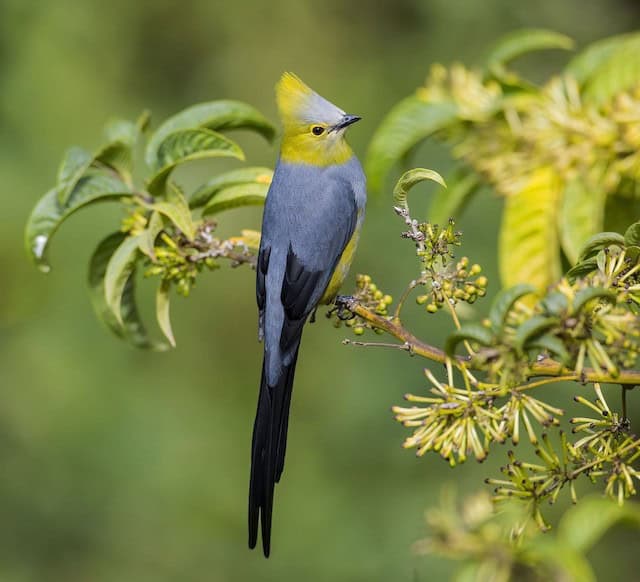
The bird’s striking colors include a crest and throat in vivid yellow-blue-gray tones along its back, lower breast, and upper belly, and a bold black tail and flight feathers. The outer tail feathers have delicate white spots, adding to the bird’s visual appeal.
The female differs from the male, measuring slightly smaller at 21 cm, with a darker gray forehead, olive body plumage, and a shorter, less glossy tail. Juveniles resemble adults but have shorter central tail feathers and less pronounced white spotting.
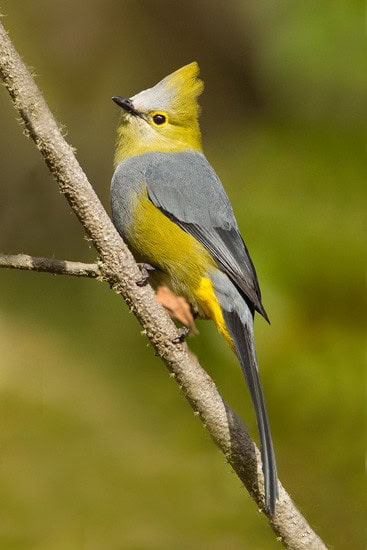
Found in the mountain forests, secondary forests, and wooded ravines between 1,850 meters and the timberline, the Long-Tailed Silky-Flycatcher thrives in its limited habitat.
Outside the breeding season, these birds often gather in small flocks, feeding on insects and small fruits such as mistletoe. They are agile feeders, frequently seen sipping nectar from plants and hummingbird feeders, sometimes even hanging upside down to eat.
The breeding season occurs between April and June, during which pairs build cup-shaped nests made of lichen, caterpillar silk, or spider web, often hidden in dense foliage. The male and female work together to construct the nest, and the male feeds the female during this period.
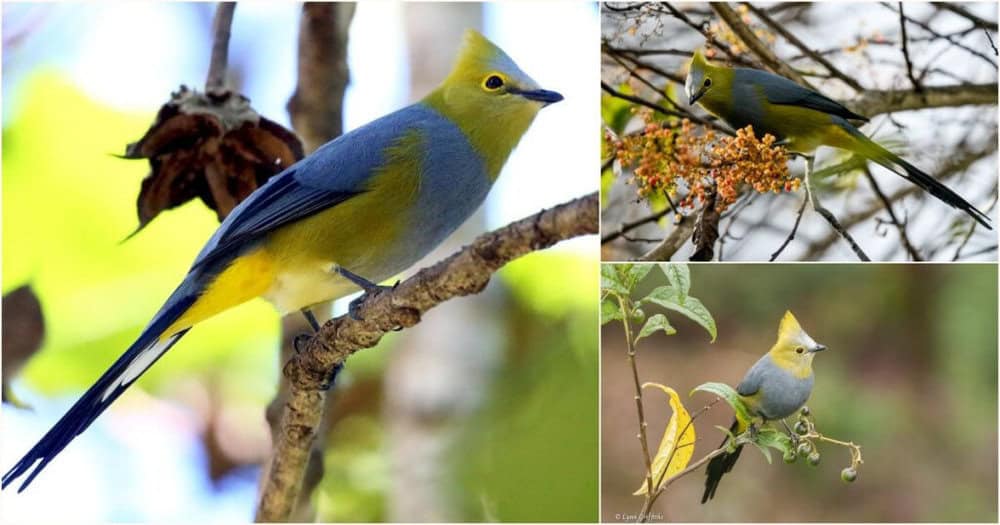
Females lay about two eggs, incubated for 16 to 17 days, while both parents feed the chicks until they leave the nest around 24 to 25 days later.
Despite being considered common, the Long-Tailed Silky-Flycatcher faces threats from habitat destruction due to activities such as logging, burning, and agriculture.
As these birds continue to grace the mountainous landscapes, it is crucial to appreciate their unique beauty and support efforts to protect their habitat, ensuring their survival for future generations.
Read More Birds